
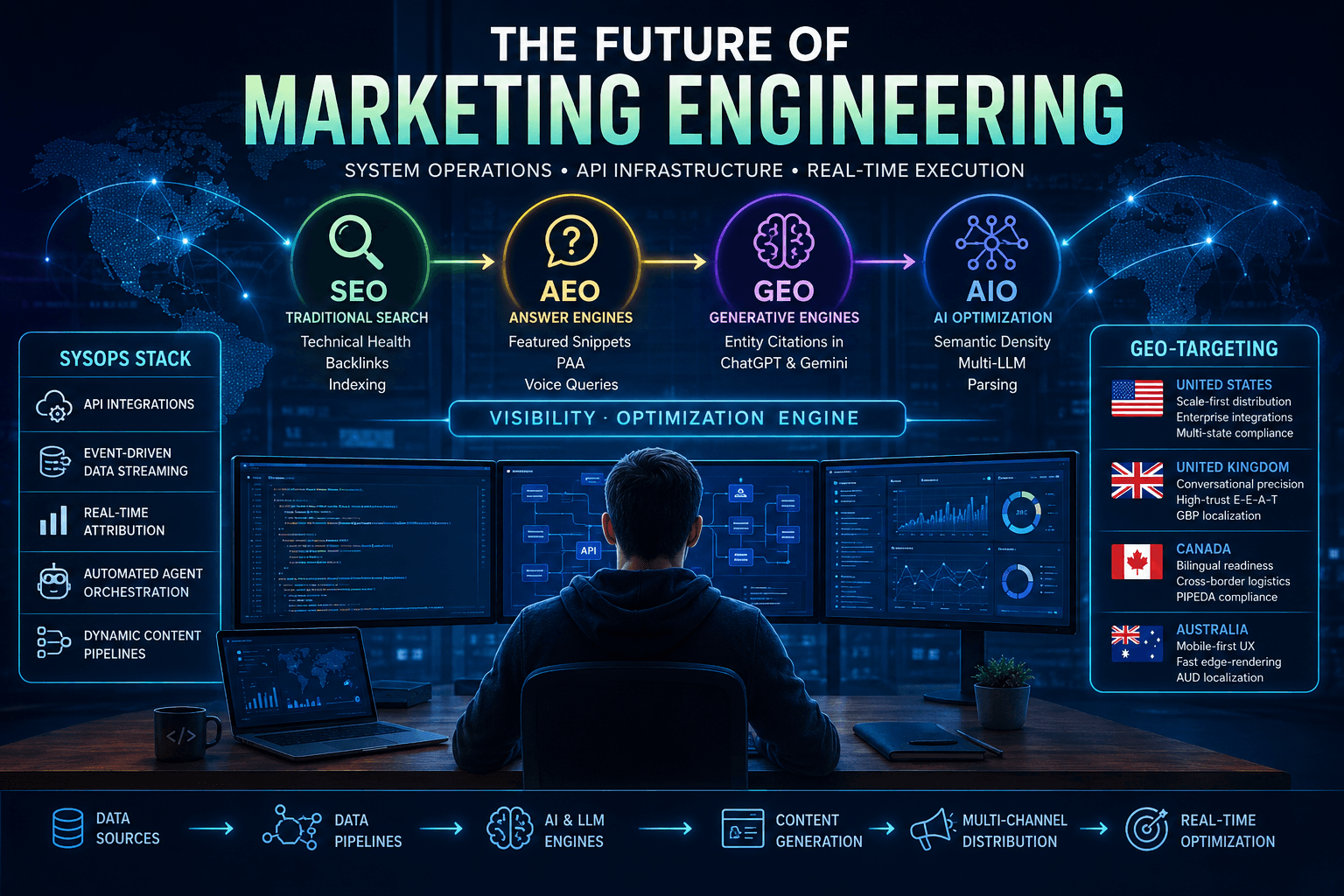
The shift in modern digital growth is clear. Marketing is no longer just about ad creative or surface-level campaign management. It has fundamentally evolved into Marketing Engineering - a discipline built directly around System Operations, API infrastructure, and real-time execution engines. To thrive across primary global markets including the United States, Canada, the United Kingdom, and Australia, modern growth leaders must optimize for the full search spectrum. This means combining classic SEO with GEO (Generative Engine Optimization), AEO (Answer Engine Optimization), AIO (AI Optimization), and location-specific geo-targeting.
The Death of Siloed Campaigns and the Rise of Marketing Engineers
For over a decade, digital marketing operated in distinct silos. Copywriters wrote ads, media buyers adjusted budgets, and web developers built landing pages. Today, automated generative models and autonomous agent workflows have collapsed those boundaries. Marketing Engineers do not manage campaigns manually - they build the systems that build, test, and optimize campaigns autonomously. System Operations has become the core architecture of enterprise growth.
The shift is from asking how to write a high-converting ad, to asking how to build an API pipeline that generates, renders, tests, and shifts budget across 500 localized ad variants simultaneously.
Marketing engineers now deploy event-driven data streaming, custom webhooks, real-time attribution modeling, and automated agent orchestration. The SysOps stack has replaced the spreadsheet as the central operating layer of a modern marketing function.
The Four Pillars: SEO, AEO, GEO and AIO
Modern marketing engineers design digital experiences optimized for both human users and advanced language models. Capturing organic traffic across the US, UK, Canada, and Australia requires balancing four essential visibility pillars working together as a single optimization engine.
- SEO - Traditional Search: Maintaining high performance, structured data, clean DOM hierarchies, and canonical web standards. Technical health, backlinks, and indexing remain the foundation everything else is built on.
- AEO - Answer Engine Optimization: Structuring content into clear, self-contained, schema-tagged question and answer formats optimized for Google AI Overviews, voice assistants, and instant featured snippets. People Also Ask is now a primary acquisition channel.
- GEO - Generative Engine Optimization: Engineering content with verified facts, original research, and clear entity relationships so generative tools like ChatGPT and Gemini cite your brand as a core source. Entity citations in AI-generated answers are the new backlinks.
- AIO - AI Optimization: Structuring backend content architectures so multi-modal models can index, parse, and recommend your services seamlessly. Semantic density and multi-LLM parsing capability determine whether AI systems include or exclude your brand.
Regional Geo-Targeting Framework Across US, UK, Canada and Australia
A global System Operations model must automatically adjust content, intent, and regulatory compliance based on regional signals. Each country operates under a distinct technical and regulatory environment that a marketing engineering architecture must account for natively.
- United States: Scale-first programmatic distribution, enterprise integrations, and multi-state tax and privacy engines. Requires CCPA and CPRA compliance, multi-region CDN routing, localized currency, and state-level schema markup.
- United Kingdom: Conversational precision, high-trust E-E-A-T signals, and direct-to-consumer value messaging. Requires strict GDPR and PECR consent architecture, GBP pricing localization, and UK-hosted edge nodes.
- Canada: Bilingual technical readiness in English and French, cross-border logistics data integrations. Requires PIPEDA data compliance, CAD currency formats, and localized geo-location hreflang tags.
- Australia: High-intent mobile UX, fast edge-rendering to bypass latency, and localized social proof. Requires Privacy Act compliance, AUD localization, and Sydney and Melbourne AWS and GCP edge caching.
The SysOps Stack That Powers Modern Marketing
The infrastructure layer of marketing engineering runs on five interconnected components that replace manual campaign management entirely.
- API Integrations: Connecting customer data platforms, CRMs like Salesforce and HubSpot, and generative LLM endpoints without relying on basic third-party connectors. Direct API control eliminates platform dependency and enables real-time data flow.
- Event-Driven Data Streaming: Every user action triggers a data event that feeds attribution models, bidding engines, and content personalization systems simultaneously. No batch processing, no lag, no missed signals.
- Real-Time Attribution: Customer conversion data automatically adjusts ad bidding thresholds and dynamic page variations without human intervention. The system learns and adapts continuously.
- Automated Agent Orchestration: Autonomous agents generate, test, and rotate ad variants, landing pages, and content blocks based on performance signals. One engineer manages what previously required a team of ten.
- Dynamic Content Pipelines: Structured templates built in frameworks like Next.js ingest data arrays and render localized, AI-optimized pages automatically. Content becomes infrastructure rather than individual documents.
Structuring Your Career in Marketing Engineering
To future-proof your position in the marketing engineering era, structure your skill set around system control rather than execution. The practitioners who build leverage through systems will consistently outperform those who build leverage through volume of manual effort.
- Master API-first workflows: Learn to connect CDPs, CRMs, and generative LLM endpoints directly. Platform dependency is a career ceiling. API fluency removes it.
- Treat content as data infrastructure: Move away from isolated blog posts. Build structured dynamic templates that ingest data arrays and render localized, AI-optimized pages automatically.
- Integrate real-time analytics: Build feedback loops where conversion data automatically adjusts bidding thresholds and page variations. Closed-loop systems compound in performance over time.
- Prioritize privacy and compliance infrastructure: Understand how GDPR, CCPA, PIPEDA, and the Australian Privacy Act impact data pipelines. Zero data leakage is a technical requirement, not a legal afterthought.
What This Means for Businesses in 2026
For businesses operating across the US, UK, Canada, and Australia, the marketing engineering shift creates an immediate competitive divide. Companies that continue running manual campaign management against competitors running autonomous SysOps architectures will find themselves permanently outspent and outranked - not because of budget differences, but because of infrastructure differences.
The agencies and in-house teams that win in 2026 and beyond are not the ones with the best copywriters or the most creative campaigns. They are the ones who built systems that learn, adapt, and execute faster than any human team can respond. Marketing engineering is not the future of the industry - it is the current state of the industry at the performance frontier.