
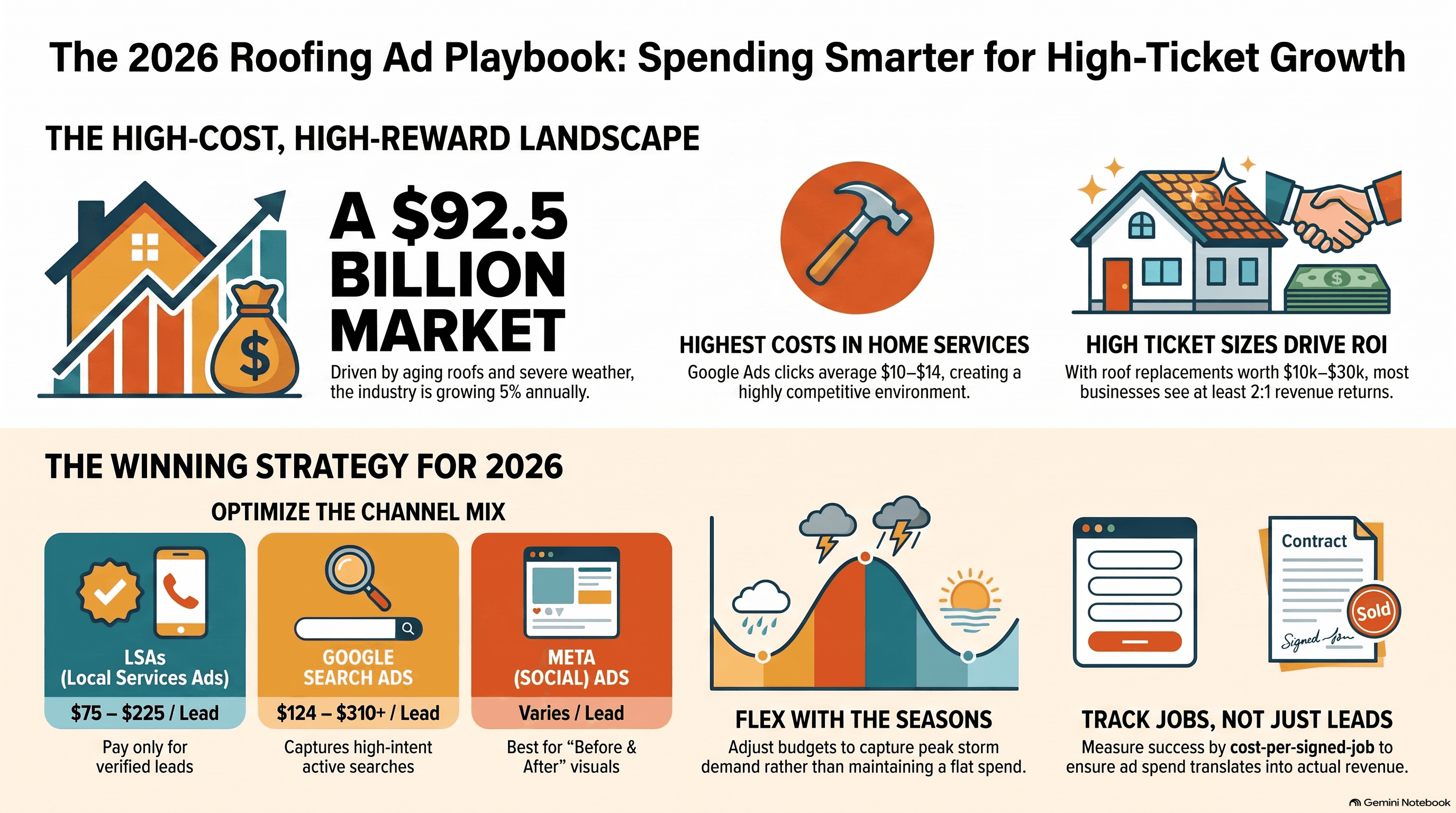
The US roofing contractor market reached $92.5 billion in 2026, growing at a 5.0% CAGR over the past five years. That demand does not come from new construction - roughly 80% of roofing demand comes from re-roofing and renovation, making it resilient to new-construction slowdowns. Roofs age whether the economy grows or contracts. The median American home is now around 40 years old, and the median roof age exceeded 17 years in 2025, pushing millions of homes past their warranty period.
There are 101,679 roofing contractor businesses in the US, up 2.7% year over year. All of them are competing for the same homeowners on the same search results page. Homeowners research online first - 98% search and 76% read reviews before requesting an estimate. The homeowner decision journey begins on Google, which is why Google Ads is the dominant lead acquisition channel for roofing contractors in 2026.
The Market Reality: Why Roofing is One of the Most Competitive Markets on Google
Roofing has the worst conversion rate in home services at 3.70%, reflecting the high-consideration, high-ticket nature of roofing jobs. Homeowners click ads to compare options and request multiple quotes before deciding. A roof replacement is often the largest single purchase a homeowner makes between major renovations. They are cautious. Your ads, landing pages, and intake process need to account for that caution at every step.
Roofing is the most expensive category on Google Ads for a reason - a single closed job generates anywhere from $8,000 to $25,000 in revenue. The math works even at $10 per click. What breaks the economics is poor campaign structure, wrong landing pages, and slow lead response.
What You Will Actually Pay Per Click - And Why the Math Still Works
The average cost per click for roofing services is $10.25, with most advertisers seeing cost per lead between $94 and $170 depending on quality score, location, and keyword match strategy. These are national averages. In competitive metros, the numbers climb sharply - top-20 metros push roof replacement CPCs to $35 to $50 per click, and storm restoration terms in Phoenix, Dallas, and Atlanta hit $54 or more per click during hail season.
- National avg CPC: $10.25 - Range: $7.69 to $13.84
- Major metro CPC: $35 to $65 in Dallas, Phoenix, and Atlanta
- Storm keyword CPC: $54+ during hail and wind events
- Average cost per lead: $94 to $170 on managed campaigns
- Industry average ROAS: 7x - $7 revenue for every $1 spent
- Wasted spend: Approximately 32% in unmanaged accounts
Here is why these numbers are not frightening - they are justifiable. A residential roof replacement typically runs $8,000 to $25,000. Even at a $150 cost per lead and a 25% close rate, you are paying roughly $600 per acquired job on a $15,000 revenue contract. With an average ROAS of 7x, roofing Google Ads campaigns typically generate $7 in revenue for every $1 spent. The math works - but only when the campaign is structured correctly and the lead intake process is fast enough to convert what the ads produce.
The Four-Campaign Structure Every Roofing Contractor Needs
The most common mistake roofing contractors make on Google Ads is running a single campaign with a mix of services, keywords, and audiences all in one place. A roofing company should have separate campaigns for roof repair, roof replacement, and roof inspection because these services have different values and different competitive dynamics. This structure allows you to allocate budget proportionally to your highest-margin services and measure performance accurately by job type.
- Search - Roof Replacement (40% of budget): Highest average job value. Keywords: roof replacement near me, new roof cost, reroof my house. A single signed contract justifies the entire month of ad spend. This is your primary revenue campaign.
- Search - Emergency and Repair (30% of budget): Fastest path to a phone call. Keywords: emergency roof repair, roof leak repair near me, storm damage roof repair. Emergency intent converts at higher rates because the homeowner has no time to shop around.
- Local Services Ads (20% of budget): Pay per verified lead, not per click. The Google Guaranteed badge increases call rates significantly. Lowest cost per lead of any paid channel for roofing contractors.
- Storm and Insurance Restoration (10% baseline): Built and ready before storm season. CPC spikes 2x to 3x during surges - having this campaign pre-built means you capture leads while competitors scramble to set up from scratch.
Which Keywords Actually Produce Roofing Leads
The best roofing PPC keywords focus on urgent, high-intent searches from homeowners who are ready to fix a problem now, not just research. The distinction matters enormously because a broad term like roofing attracts a completely different audience from emergency roof leak repair near me - and you pay the same CPC for both.
- High-intent keywords to bid aggressively on: roof replacement near me, emergency roof repair, roof leak repair city, storm damage roofer, roof replacement cost, roofing contractor city, new roof installation, hail damage roof repair
- Negative keywords to block from day one: DIY roof repair, how to roof, roofing materials, roofing jobs, roofing salary, roofing training, roof coating paint, metal roofing sheets
Less than 9% of keywords in unmanaged roofing PPC accounts actually produce leads. The other 91% burn three-quarters of the budget. Tight match types from the start prevent Google's automation from finding that other 91%.
Why Your Landing Page Matters More Than Your Ad Budget
If your campaign is sitting below 3% conversion rate, the problem is almost always the landing page, not the ad. Sending traffic to a homepage that mentions repair, gutter cleaning, and insurance restoration with equal weight is the single most common cause of poor roofing campaign performance. The homeowner who searched emergency roof leak repair clicked your ad expecting to find a page that talks about emergency roof leak repair - not a generic homepage about everything you offer.
- One landing page per service type: Replacement traffic goes to a replacement page. Repair traffic goes to a repair page. Storm damage traffic goes to an insurance claim page. Each page talks exclusively about the one service the visitor searched for.
- Phone number above the fold, always: A homeowner with a leak cannot wait. Your click-to-call number must be visible without scrolling on both desktop and mobile. This single change can lift conversion rates by 20 to 40% on roofing campaigns.
- Page load time under 3 seconds: Every additional second of load time reduces conversion rate by approximately 7%. Roofing customers in an emergency will not wait for a slow page.
- Local credibility signals above the fold: Mention the city in the headline. Show photos of local jobs. Display your licence number, insurance status, and years serving the area.
- Social proof close to the CTA: Google reviews, before-and-after photos of recent local jobs, and homeowner testimonials directly above your contact form significantly increase the likelihood a visitor converts.
How to Win the Storm Season Surge
Storm events are the highest-opportunity moments in roofing Google Ads - and the most chaotic. After a major hail or wind event, search volume for emergency roof repair and storm damage roofer can spike three to five times overnight. At the same time, CPC might double or even triple as competition increases. The roofers who win during storms are not the ones who react fastest - they are the ones who prepared first.
- Build Campaign 4 before storm season starts: Your storm and insurance restoration campaign should be built, approved, and sitting in a paused state before a single storm arrives. When weather events hit, you activate in seconds rather than building from scratch.
- Create dedicated insurance claim landing pages: Homeowners filing insurance claims need different information from those paying out of pocket. A dedicated page covering the insurance restoration process closes at a significantly higher rate.
- Increase budget aggressively during events: Storm season is not the time for budget conservatism. When search volume triples, your campaign should be set to capture that demand.
- Geofence to the affected neighbourhoods: After a major event, target the specific zip codes hit hardest. Your ads become hyper-relevant to the homeowners who need you most.
Six Costly Mistakes That Kill Roofing Google Ads Campaigns
- Sending all traffic to your homepage: Every campaign needs its own landing page. Roof replacement traffic should land on a page that talks exclusively about replacement - not one that also mentions repairs and gutters in the same breath.
- Using broad match keywords without conversion data: Start with phrase match and exact match on your highest-intent keywords. Broad match is a late-stage tool, not a starting point.
- Ignoring negative keywords: Less than 9% of keywords in unmanaged roofing accounts produce leads. Build your negative keyword list from day one: DIY, how to, materials, training, jobs, career.
- No phone number above the fold: A homeowner with a leaking roof wants a phone number, not a form. Your landing page must have a click-to-call button visible without scrolling on both desktop and mobile.
- Competing with national lead aggregators on the same keywords: Angi and HomeAdvisor bid on the same keywords you do and sell your lead to five other contractors simultaneously. Differentiate with hyper-local keywords that include your specific city.
- Not responding to leads within 5 minutes: Responding within 5 minutes makes you 21x more likely to win the job. Your ad spend is wasted if your CRM is not set up to alert your sales team the moment a lead comes in.
How to Calculate Your Roofing Google Ads Budget
The right budget for a roofing contractor is not a round number - it is a calculation. Set your monthly job target, divide by your close rate to find leads needed, then multiply by your market cost per lead. For example: 8 jobs per month at 25% close rate requires 32 leads. At $130 cost per lead that is $4,160 per month in ad spend.
- Entry-level market ($1,500 to $2,500 per month): Smaller metro areas with fewer competitors. Expect 10 to 18 qualified leads and 3 to 5 signed jobs monthly.
- Competitive market ($3,000 to $5,000 per month): Mid-size cities with active competition. Expect 20 to 35 qualified leads and 5 to 9 signed jobs monthly.
- Major metro ($6,000 to $12,000+ per month): Dallas, Phoenix, Atlanta, Los Angeles. Higher CPC requires larger budget for the same lead volume. Expect 35 to 70+ qualified leads with proper management.
The 5-Minute Rule - Why Slow Lead Response Destroys Your ROI
Responding to an estimate request within 5 minutes makes you 21x more likely to win the job. On exclusive PPC leads with fast follow-up, booking rates reach 35 to 40%. On aggregator leads where your quote competes with 5 to 10 others simultaneously, close rates drop to 5 to 15%. The difference is not the lead quality - it is the speed and exclusivity of your response. Your Google Ads investment is only as valuable as your intake process is fast.