
The Basics Haven’t Changed — But the Scale Has
What are Google Ads? It is still a pay-per-click (PPC) advertising platform at its core. You bid to show ads to people based on what they’re searching for, who they are, or what content they’re consuming. You only pay when someone clicks.
What has changed is the sheer scale and sophistication of the system. Google now processes over 16.4 billion searches per day. Its ad platform spans Search, YouTube, Gmail, Google Maps, Google Display Network, Google Discover, and now AI-generated search experiences. When you run Google Ads, you’re not just buying keywords; you’re buying access to the most widely used information infrastructure on the planet.
Where Your Ads Can Appear in 2026
In 2020, the conversation was mostly Search vs. Display. Today, Google Ads reaches users across a much wider surface area:
- Google Search
- Google Display Network (GDN)
- YouTube
- Gmail
- Google Discover
- Google Maps
- Google Shopping
- AI Overviews
- AI Mode
The Big Shift: From Manual Control to AI-Driven Automation
The most significant change in Google Ads over the past few years isn’t any single feature; it’s the underlying philosophy. Google has steadily moved from a system in which advertisers manually controlled nearly everything (keywords and ad copy) to one in which AI makes many of those decisions automatically.
This is a real adjustment for experienced advertisers. The instinct is to want maximum control. But the data increasingly shows that AI-assisted campaigns, when given good inputs, outperform heavily manual campaigns. The key phrase there is when given good inputs. The AI is only as smart as the data you feed it: your conversion signals, audience lists, creative assets, and budget.
We’ll come back to this throughout the guide. The short version: embrace automation, but don’t abdicate responsibility for strategy.
New Ad Types Worth Knowing
Performance Max is Google’s AI-driven campaign type that runs across all of the channels above simultaneously, Search, Display, YouTube, Gmail, Discover, Maps, and Shopping, in a single campaign. Instead of managing individual placements and bids, you give Google a budget, a goal, and a set of creative assets, and its AI figures out where and how to show your ads.
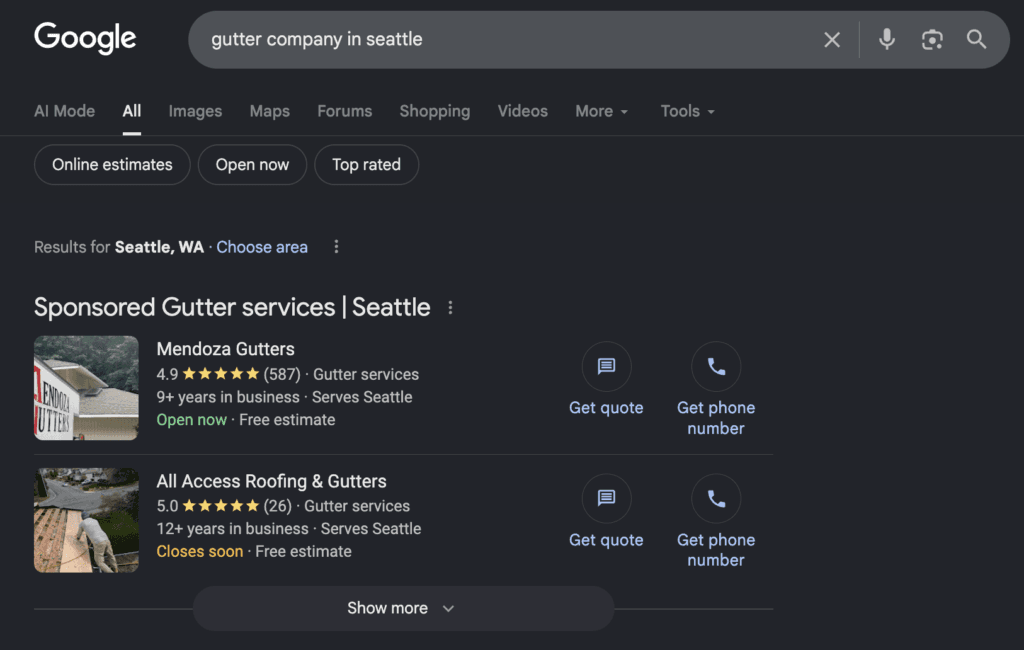
Local Services Ads (LSAs) have been around since 2019, but haven’t gained as much attention until recently. They are a separate Google product specifically for local service businesses; home services, legal, healthcare, and more. Unlike standard Google Ads, LSAs charge per lead rather than per click, and appear at the very top of search results above regular ads. For qualifying businesses, they’re often the highest-ROI starting point in Google’s ecosystem.
Campaign Types — A 2026 Overview
Here’s a current breakdown of the campaign types, their best use cases, and other notable information.
Search Campaigns
Google Search Ads are the original Google Ads format. They are text ads triggered by keyword searches that appear at the top and bottom of Google’s search results page.
Best for: High-intent, bottom-of-funnel users actively seeking what you offer. This includes generating leads through a form or phone call.
What’s new: New in 2025 and arguably the most important development for Search advertisers is AI Max for Search. AI Max isn’t a new campaign type — it’s a suite of AI-powered features you can layer onto existing Search campaigns. Think of it as Search campaigns with the intelligence turned up significantly. Key AI Max features include Search Term Matching, URL Expansion, and more.
When to use it: Almost always. Search campaigns should be the foundation of most Google Ads accounts. If someone is searching for exactly what you do, you want to be there.
Display Campaigns
Display Ads are visual ads that are shown across Google’s network of up to 35 million websites, apps, and Google-owned properties.
Best for: Brand awareness, retargeting past website visitors, and reaching users earlier in the buying journey.
What’s new: Google has added AI-powered creative tools to Display — you can now animate static images, adjust aspect ratios, and generate new creatives from existing brand assets. Display inventory now also includes placements on X (formerly Twitter) via the Google Display Network.
When to use it: Retargeting campaigns for almost any business. Awareness campaigns for businesses with longer sales cycles or higher-consideration purchases.
Video (YouTube) Campaigns
Video ads are served before, during, or after YouTube videos, as well as in YouTube search results, and across the Google Video Partners network.
Best for: Brand awareness, product demonstrations, telling a story that requires more than a headline and description.
When to use it: When you have video creative and ad spend budget to invest in upper-funnel awareness. It is also effective for retargeting.
Performance Max (PMax)
Performance Max is a single campaign type that runs across all of Google’s channels simultaneously, using Google’s AI to allocate budget where it predicts the best conversions.
Best for: Advertisers who want full-funnel coverage and are willing to trust Google’s AI to find converting users across channels. If your goal is to drive in-store traffic, PMax’s full-channel coverage is a valuable asset.
What you control:
- Your budget and bidding goal
- Asset groups
- Audience signals
- Brand exclusions
What you don’t directly control: Which channels get ad spend, which ad formats run, and individual placement choices.
When to use it: When you have solid conversion tracking set up and enough conversion volume for the AI to learn. It can be a black box, and it requires ongoing asset testing as well as audience signal refinement. Don’t set it and forget it.
Demand Gen Campaigns
Formerly known as Discovery campaigns, Demand Gen was rebuilt in 2023–2024 to focus on capturing demand in visual, content-native environments: YouTube (including Shorts), Gmail, and Google Discover.
Best for: Mid-funnel awareness and consideration, targeting users who aren’t actively searching, but they’re open to discovery.
When to use it: As part of a full-funnel strategy alongside Search and Performance Max. Good for brands with strong visual creative.
Shopping Campaigns
Shopping ads list products directly in Google Search results with an image, title, price, and store name. This is essential for e-commerce businesses.
Best for: Online retailers with a product feed. Shopping ads tend to have high purchase intent since users can see the product and price before clicking.
When to use it: You are an e-commerce business.
App Campaigns
These are designed specifically to drive mobile app installs or in-app actions. Google’s AI automatically creates and optimizes ads across Search, Display, YouTube, and Google Play.
Best for: Mobile app developers and businesses with an app they want to grow.
Local Services Ads (LSAs)
LSAs appear above standard Google Ads at the very top of search results when someone searches for a local service. They show your business name, rating, and number of reviews.
What makes LSAs different from regular Google Ads:
- Pay per lead, not per click. You’re charged when a potential customer calls, messages, or books through your ad — not just when they click. This makes the ROI math much more straightforward.
- Google Verified. To run LSAs, your business goes through a background check and license verification process. This process is intended to provide a credibility signal to consumers making high-stakes purchasing decisions.
- No keywords to manage. Google matches your ads to relevant local searches automatically based on your business category, services, and location. Setup is significantly simpler than traditional Search campaigns.
- LSAs live on a different platform. Although LSAs are a form of Google Ad, you cannot find LSAs within the Google Ads interface. It lives in its own separate platform.
Who qualifies: LSAs are available for a specific list of business categories, including home services, legal services, financial planning, and more. Google continues to expand the list of eligible categories. Check their website to see if your industry is eligible.
How the LSA auction works: Unlike Google Ads, which relies heavily on bid amounts and Quality Score, LSA rankings are primarily determined by your proximity to the searcher, your review score and volume, your responsiveness to leads, and how well your business category and services match the search. Budget still plays a role; if you’ve hit your weekly budget cap, your ads won’t show, but it’s less of a pure bidding war.
Best for: Any local service business in an eligible category. Home services such as plumbers, HVAC, electricians, roofers, cleaners, and landscapers see strong performance from LSAs. If you’re not running them already and you qualify, this is often the highest-priority recommendation we make.Running LSAs alongside Google Ads Search campaigns: These two ad types complement each other well. LSAs capture leads at the very top of the page with a trust-heavy format. Search campaigns give you more control over targeting, messaging, and landing page experience. Running both maximizes your presence on the search results page and covers different searcher intents and behaviors.
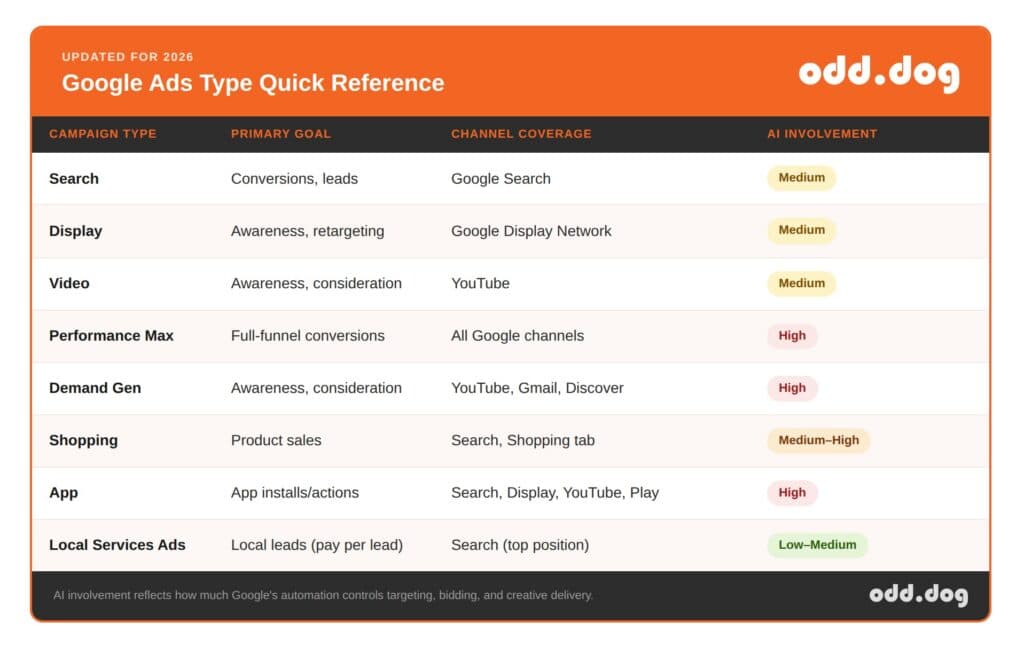
Campaign Type Quick Reference
Vipin
Digital strategist focused on scalable websites, search visibility, product design, and growth marketing.