
Most small businesses waste their first three months and half their budget on Google Ads. Not because the platform does not work, but because they follow Google's default recommendations instead of running campaigns built around their specific economics. Google's defaults are designed for advertisers who want scale. Small businesses need the opposite: tight targeting, minimal waste, and every dollar accountable to a real business outcome.
In 2026, the platform has changed significantly. AI Max, Performance Max updates, Enhanced Conversions for Leads, and a more aggressive push toward automation have all shifted what works and what burns money. This guide covers the strategies that are actually producing results for small businesses right now, and the mistakes that are silently draining budgets across every industry.
Why Google Ads Works Differently for Small Businesses
A Fortune 500 company can run broad campaigns, collect data at scale, and let Google's AI optimise toward profit over three to six months. A small business with a $1,500 monthly budget cannot afford that learning period. Every dollar that goes to an irrelevant search, a poorly converting landing page, or a keyword with no commercial intent is a dollar that does not come back. The margin for error is close to zero.
This constraint is also a competitive advantage. Google's algorithm prioritises relevance and Quality Score over budget size. A well-structured campaign from a local business with tight ad group themes, strong landing page alignment, and a 10 Quality Score can appear above a national competitor spending ten times more per month. Small business Google Ads is not about outspending the competition. It is about outstructuring them.
The Right Minimum Budget in 2026
The most common budgeting mistake small businesses make is starting too low to generate usable data, then concluding that Google Ads does not work. The practical minimum budget depends on your industry's cost per click and your target number of monthly leads.
- $300 per month: At a $5 average CPC this buys roughly 60 clicks per month. If 10% convert to a lead, that is 6 leads. Enough to test whether the platform works for your business but not enough volume to feed Smart Bidding or identify meaningful patterns. Use this budget only for initial testing in low-competition local markets.
- $600 per month: Around 120 clicks at $5 CPC, producing 12 leads at a 10% conversion rate. A reasonable starting point for low-competition local service businesses in suburban markets. Still too low for competitive industries like legal, HVAC, or home improvement in major cities.
- $1,000 to $2,500 per month: The practical starting range that most Google Ads professionals recommend for small businesses in 2026. Enough volume to generate meaningful conversion data within 30 to 60 days, sufficient to test two or three keyword themes, and enough to feed Smart Bidding once 30 conversions are accumulated.
- $2,500 to $5,000 per month: Required when clicks are expensive (legal, financial, home improvement in major metros), the service area is large, or you need results to arrive faster than a 90-day data collection period allows. At this level you can run separate Search campaigns for each service line rather than combining everything into one.
The practical floor is spending enough to get at least 50 to 100 clicks per month. Below that threshold, you will not have enough signal to optimise, and every metric you see will be statistically unreliable.
Campaign Structure: What to Build First
Small businesses should start with a single, tightly focused Search campaign - not Performance Max, not Display, not Video. Search campaigns target people actively searching for what you offer. That intent signal is the most valuable thing Google Ads provides, and small budgets should be concentrated entirely on capturing it before doing anything else.
- One campaign per primary service: If you are a plumber, start with one campaign for emergency plumbing. Not general plumbing, not pipe installation, not drain cleaning - one primary service that generates your highest-value jobs. Add additional service campaigns only after the first one is consistently profitable.
- Tight ad groups with three to five keywords each: Each ad group should target one specific intent. An ad group called 'Emergency Plumber' should contain keywords like 'emergency plumber near me', '24 hour plumber', and 'plumber available now'. Not 'plumber', not 'plumbing services', not 'plumbing company'. Those go in separate ad groups.
- Phrase and exact match only: Do not use broad match keywords until you have at least 90 days of conversion data and a negative keyword list with 100 or more terms. Broad match on a small budget is how you end up paying for searches like 'plumber salary' and 'plumbing apprenticeship' instead of customers.
- Dedicated landing pages per campaign: Your homepage is not a landing page. Build a page specifically for each campaign with a headline that matches the ad, a phone number above the fold, a form with three or fewer fields, and social proof specific to that service. Sending ad traffic to your homepage is one of the most expensive mistakes in small business Google Ads.
Conversion Tracking: The Most Expensive Mistake
Running Google Ads without conversion tracking is the most expensive mistake a small business can make, because it makes every other mistake invisible. Without tracking, you cannot see which keywords generate leads, which ads drive calls, or whether your budget is producing any return at all. You are flying blind in a thunderstorm.
- Set up call tracking before launch: Google Ads call extensions and call-only ads generate phone calls. If you do not track those calls as conversions, Google has no signal to optimise toward and your Smart Bidding strategy is optimising toward nothing. Use Google's native call tracking or a third-party tool like CallRail. Every inbound call from an ad should be a conversion event.
- Track form submissions, not page views: A thank-you page view is a proxy for a lead. It is better than nothing but it double-counts incomplete submissions and bot traffic. Set up a proper conversion action that fires when the form submit button is clicked and the thank-you page loads, and verify it fires correctly in Google Tag Assistant before running any spend.
- Use Enhanced Conversions: Enhanced Conversions for Leads, which became more prominent in 2026, improves conversion measurement by hashing and sending first-party customer data from your form submissions. It fills in the gaps when cookies are blocked or users switch devices. Enable it in your Google Ads account under Conversions and follow the setup instructions for your CMS.
- Do not count micro-conversions as primary: Scroll depth, time on page, and video plays are micro-conversions. They have no direct revenue value. If you count them as primary conversions, Smart Bidding will optimise toward getting people to scroll rather than getting people to call. Set calls and form submissions as primary conversions. Everything else is secondary.
Negative Keywords: The Fastest ROI Improvement Available
If you do one thing this week to improve your Google Ads results, build a negative keyword list. The search term report in most small business accounts reveals that 20 to 40% of clicks come from searches that have nothing to do with buying. Job seekers, students, researchers, competitors, and people looking for free information all click ads and cost money without ever converting.
- Job seeker terms: Add these as negatives before you launch: jobs, careers, hiring, salary, wage, apprenticeship, training course, how to become, certification, resume. A plumbing ad appearing for 'plumber salary 2026' is a wasted click every time.
- DIY and informational terms: Free, DIY, how to, guide, tutorial, tips, Reddit, forum, YouTube, review, what is, definition. Someone searching 'how to fix a leaking pipe yourself' is not going to hire a plumber.
- Competitor research terms: Vs, alternative, compare, review, complaint, better than. These indicate someone researching options, not someone ready to book.
- Review the search term report weekly: The negative keyword list is never finished. New irrelevant searches appear constantly as Google experiments with broad match and close variant matching. Spending 20 minutes each week reviewing search terms and adding negatives is the highest-ROI activity available to any small business running Google Ads.
Bidding Strategy: What to Use at Each Stage
Bidding strategy is one of the most misunderstood aspects of small business Google Ads. Google constantly pushes advertisers toward automated Smart Bidding strategies. Those strategies work - but only when they have sufficient conversion data to learn from. Before that threshold is reached, they actively harm performance.
- Months 1 to 2: Maximise Clicks with a bid cap: Maximise Clicks gets traffic flowing and generates conversion data. Set a maximum CPC bid cap at your industry benchmark to prevent Google from overpaying for individual clicks. This phase is about data collection, not profit.
- Month 3 onward: Target CPA or Maximise Conversions: Once you have 30 to 50 conversions recorded in a 30-day period, switch to Target CPA or Maximise Conversions. At this point Google's algorithm has enough data to predict which users are likely to convert and bid accordingly. Before this threshold, Smart Bidding is guessing.
- Never: Target ROAS before 90 days: Target ROAS requires even more conversion data than Target CPA to function correctly. Enabling it too early causes campaigns to underspend, miss auctions, and deliver erratic results. Wait for at least 50 conversions per month and 90 days of data before testing ROAS bidding.
Performance Max in 2026: Should Small Businesses Use It?
Performance Max earned a poor reputation with small advertisers in 2023 and 2024 by absorbing budget and reporting results that were difficult to verify. The 2026 version is more controllable. Campaign-level negative keywords now allow up to 10,000 terms. Channel reporting shows where spend is going. Search themes help steer the AI toward relevant queries. But the fundamental strategic advice has not changed: PMax should sit alongside a keyword-driven Search campaign, not replace it.
- Do not run PMax as your only campaign: Without a separate Search campaign, you have no visibility into which keywords are driving results and no control over where your budget goes. PMax will always prioritise the cheapest conversions, which are often branded searches you were already winning organically.
- Exclude your brand terms from PMax: If you do not exclude your brand name from Performance Max, it will claim credit for people who were already searching for your business by name. Those are the cheapest conversions in your account and PMax will happily report them as wins from its own work.
- Use all 50 search themes per asset group: Search themes tell PMax's AI which query categories you want to appear for. Using all 50 available themes gives the algorithm the most guidance and reduces the chance of it serving ads for irrelevant searches.
- Check the channel report monthly: If 80% of your PMax spend is going to Display and Gmail placements and your conversions are flat, you have found your problem. The channel breakdown report shows exactly where money is being spent. Adjust asset group quality and audience signals to shift spend toward Search and Shopping placements.
Local Targeting: The Small Business Advantage
Geographic targeting is where small businesses have a genuine structural advantage over national competitors. A local plumber in Melbourne's eastern suburbs can target exactly the postcodes they serve, reduce wasted spend on areas they cannot reach within a reasonable drive time, and create hyper-local ad copy that resonates with the specific community. A national plumbing franchise cannot do this with the same precision at scale.
- Target by radius around your location: Start with a 15 to 20 kilometre radius for service businesses. Review the location report after 30 days to see which suburbs are generating conversions and which are consuming budget without results. Tighten or expand based on data, not assumption.
- Use location insertion in ad copy: Ad copy that includes the suburb or city name outperforms generic copy in click-through rate and conversion rate consistently. 'Emergency Plumber in Brunswick' converts better than 'Emergency Plumber Near You' for a user in Brunswick every time.
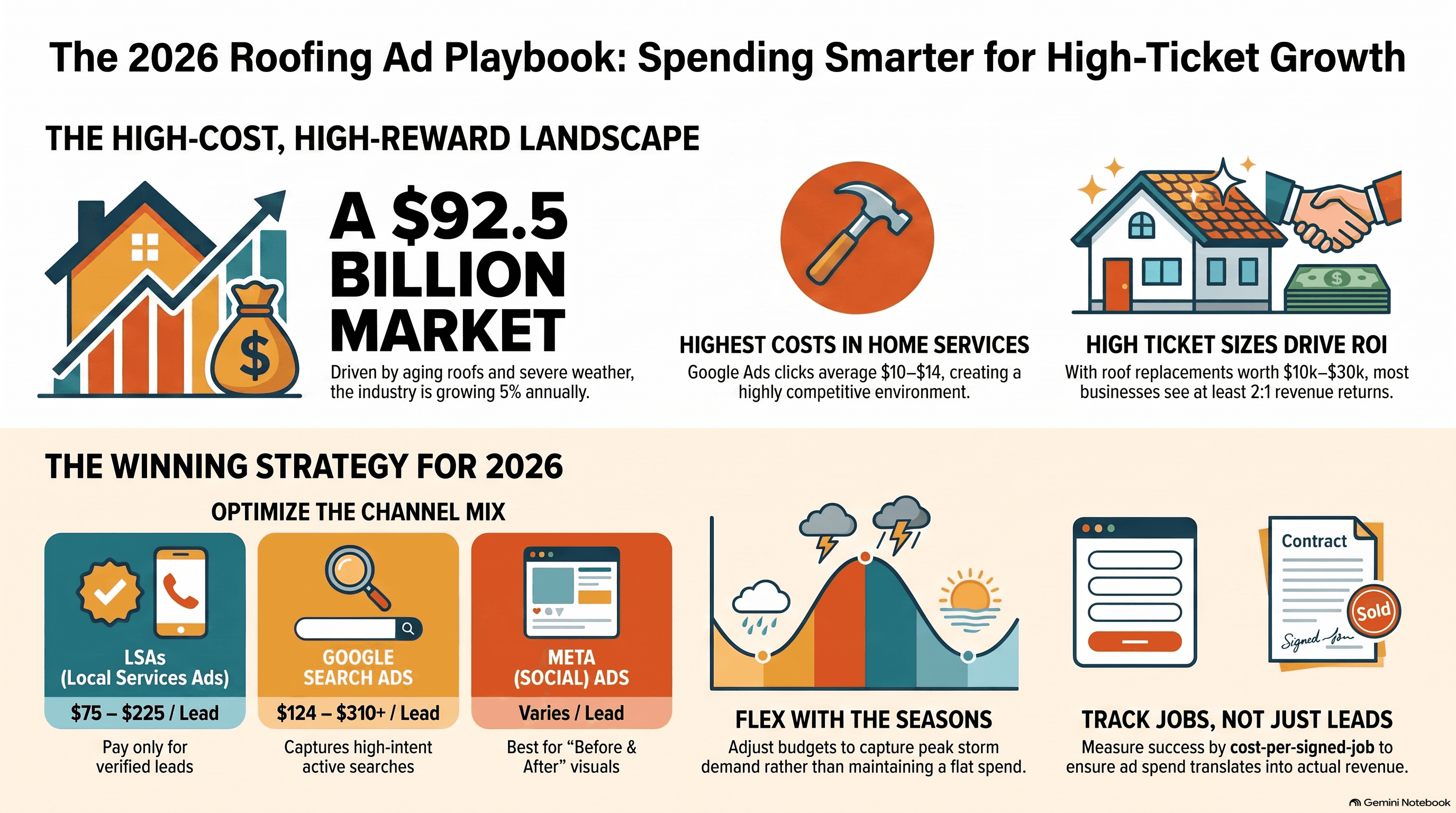
- Consider Local Services Ads alongside Search: Local Services Ads, which show above traditional Search Ads, charge per verified lead rather than per click and carry the Google Guaranteed badge. For local service businesses in categories that qualify, LSAs can deliver the lowest cost per lead of any Google advertising format in 2026.
The 90-Day Plan for a New Small Business Campaign
- Week 1 to 2: Setup: Install conversion tracking for calls and form submissions. Build a dedicated landing page for the campaign. Set up the account structure with one campaign, two to three tightly themed ad groups, and phrase and exact match keywords only. Create a negative keyword list with at least 50 terms before launch.
- Week 3 to 6: Data collection: Run Maximise Clicks with a CPC cap. Review the search term report every 7 days and add negatives. Monitor impression share, click-through rate, and conversion rate. Do not change campaign structure or bids during this phase. Let the data accumulate.
- Month 2 to 3: Optimisation: Once 30 conversions are recorded, switch to Maximise Conversions or Target CPA. Pause keywords with significant spend and zero conversions. Test a second ad variation per ad group. Review landing page heatmap data and make one conversion rate improvement based on what you see.
- Month 3 onward: Scale: Increase budget by 20% increments on campaigns hitting your target cost per lead. Add a second service campaign for your next highest-value service. Consider adding a remarketing campaign to re-engage people who visited the landing page but did not convert. This is when the compounding effect of well-structured Google Ads begins.