
The cross-industry average cost per click on Google Ads in 2026 is $5.42 according to WordStream benchmark data compiled from thousands of campaigns. But that number tells you almost nothing useful on its own. Legal advertisers pay $9.87 per click. Arts and entertainment advertisers pay $1.63. A dental practice running emergency appointment campaigns has completely different economics from an e-commerce brand running Performance Max. What Google Ads costs depends almost entirely on who is asking.
This guide breaks down the real costs in 2026 by country, by industry, and by campaign type - then shows you how to calculate whether those costs are profitable for your specific business. Because the question that actually drives smarter decisions is not what does Google Ads cost, but what should your business be willing to pay for a qualified click, lead, or customer.
Google Ads Cost by Country in 2026
Where your customers are located is one of the biggest factors determining what you pay per click. English-speaking markets with high purchasing power consistently rank among the most expensive Google Ads markets globally. Here is what businesses in the five primary markets Luceds serves actually pay.
- United States: The most expensive Google Ads market in the world. Average CPC of $5.42 across all industries in 2026, rising to $9.87 for legal services and $8.33 for home improvement. June is the most expensive month at $6.10 per click on average. February is the cheapest at $5.23. Long-tail keywords with location modifiers cost 40 to 60% less than broad category terms.
- Australia: The second most expensive market globally, driven by high consumer purchasing power and intense advertiser competition in Sydney, Melbourne, and Brisbane. B2B and professional services average $4.50 to $14.00 per click. E-commerce averages $0.90 to $2.80. Australia is approximately 10 to 15% cheaper than the US on a like-for-like basis but significantly more expensive than most other markets.
- United Kingdom: Average CPC approximately 13% lower than the US equivalent. Competitive markets like legal, finance, and property still command $5 to $8 per click. The UK market rewards high Quality Scores more aggressively than most - well-structured accounts with strong ad relevance see significantly below-average CPCs compared to poorly structured competitors.
- Canada: Average CPC approximately 25 to 29% lower than the US, making it one of the more cost-efficient English-speaking markets for advertisers. High competition in financial services and real estate pushes CPCs in those sectors close to US levels, but most service industries run at meaningfully lower costs.
- New Zealand: Average CPC approximately 14% lower than the US. A smaller market means lower absolute auction pressure in most categories, particularly outside financial services and property. NZ advertisers in local service businesses often achieve very strong ROAS due to the combination of lower CPCs and high average job values.
Both Statista and Semrush independently rank the same four markets as the most expensive Google Ads markets globally: United States, Australia, United Kingdom, and Canada. If you sell to customers in these countries, you are operating in the four most competitive auction environments on earth. Structure matters more here than anywhere else.
Google Ads Cost Per Click by Industry in 2026
Industry is the second biggest variable in your Google Ads cost. The difference between the cheapest and most expensive industries is 6x. Here are the 2026 benchmark CPCs from WordStream and Ryze AI data covering thousands of campaigns.
- Attorneys and Legal Services: $9.87 CPC - the most expensive category in 2026, up 15% year over year. Justified by client lifetime values that regularly reach five to six figures per case.
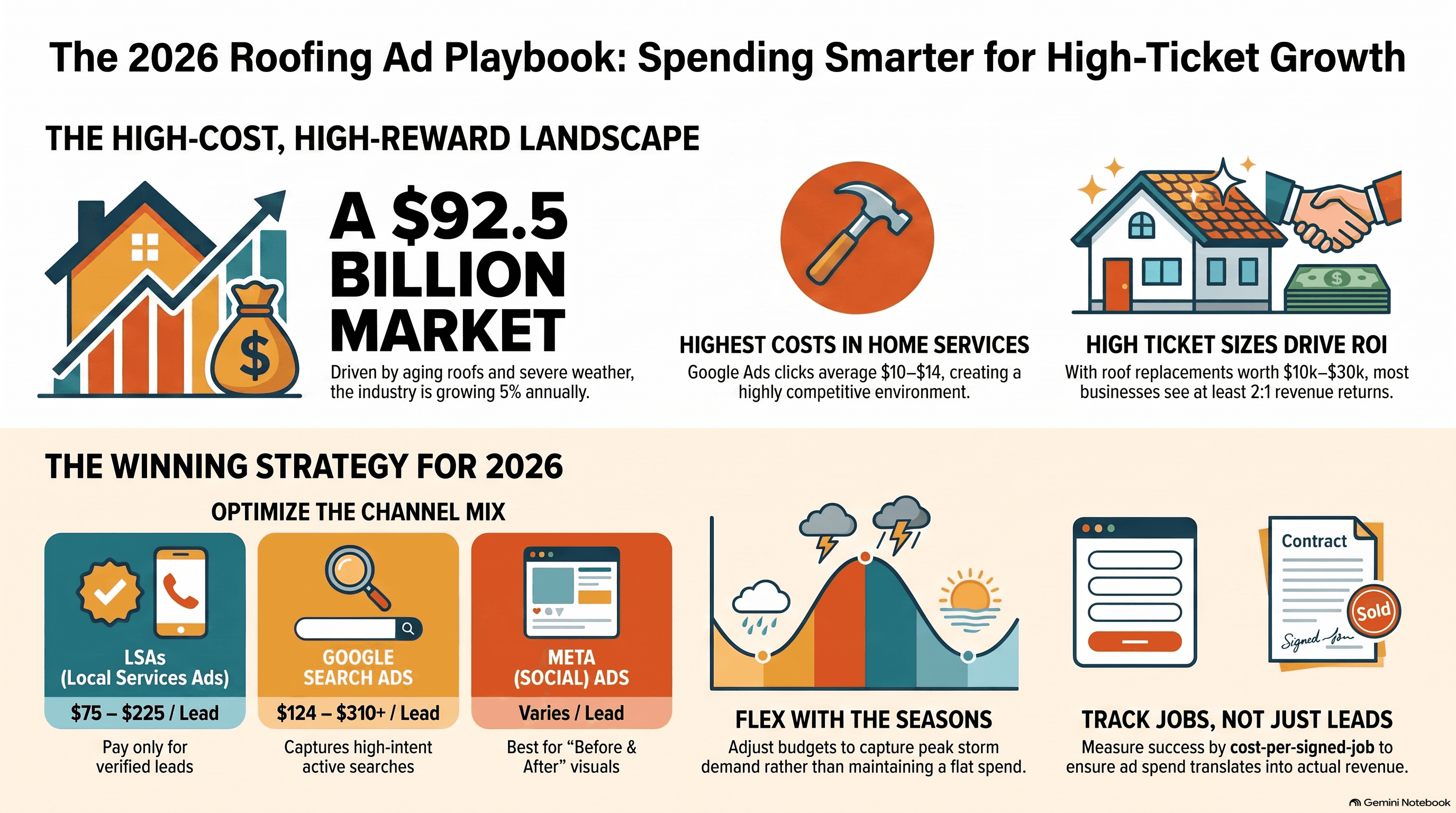
- Home and Home Improvement: $8.33 CPC - roofing, HVAC, plumbing, and remodeling all sit in this range. High average job values ($5,000 to $30,000) make these CPCs very profitable when conversion tracking is correct.
- Dentists and Dental Services: $8.00 CPC - emergency and cosmetic dental terms drive the highest costs. General dentistry and preventive care keywords are significantly cheaper.
- Finance and Insurance: $5.16 to $7.00 CPC range. Mortgage, insurance, and investment keywords are among the most competitive in every market.
- Real Estate: The biggest year over year CPC increase in 2026 at up 27.27%. Buyer and seller intent keywords now average $6.50 to $8.00 in major US metros.
- E-Commerce: $1.16 CPC average for Search Ads, making it the cheapest category. Shopping Ads average $0.63 to $0.90, making them an even more cost-efficient entry point for product-based businesses.
- Restaurants and Food: $2.05 CPC. Lower competition and lower average transaction values characterise this category. Local and delivery-focused keywords perform best.
- Arts and Entertainment: $1.63 CPC - the lowest of any category tracked. Low competition but also typically lower conversion values, so ROAS optimization requires volume.
Google Ads Cost by Campaign Type in 2026
The campaign format you choose dramatically affects what you pay per click. Not all clicks are created equal - Search clicks from people actively searching for your service convert at a far higher rate than Display or YouTube clicks, which is why the CPC differences between formats are justified.
- Search Ads: $2.96 to $5.42 CPC - the cross-industry average range depending on the data source. Highest intent, highest conversion rates, highest CPC. The right starting point for almost every business.
- Display Ads: $0.44 CPC average. 85% cheaper than Search but significantly lower conversion intent. Best used for remarketing to warm audiences, not cold prospecting on small budgets.
- Shopping Ads: $0.63 to $0.90 CPC for e-commerce. Product images and prices show directly in results, pre-qualifying the click before it happens. Often the highest-ROAS campaign type for product businesses.
- YouTube Ads: $0.49 CPC. Cost per view (CPV) averages $0.026. High reach at low cost but lower direct conversion rates. Effective for brand building alongside Search campaigns.
- Performance Max: European benchmark data shows PMax averaging around $0.41 CPC equivalent on the Display and YouTube inventory it accesses, with Search-equivalent CPC on Search placements. Results vary significantly by industry and how well the campaign is set up with asset groups and audience signals.
- Local Services Ads: Pay per verified lead, not per click. Typical cost per lead of $15 to $50 depending on industry. The Google Guaranteed badge increases conversion rates and the pay-per-lead model removes the CPC risk entirely.
The Metrics That Actually Tell You Whether Google Ads is Worth It
CPC is the most talked-about Google Ads metric and one of the least useful on its own. A $9 click that converts 15% of the time into a $15,000 roofing job is extraordinarily profitable. A $2 click that converts 0.5% of the time into a $200 order may not be. The three metrics that actually determine whether Google Ads is generating a return for your business are cost per lead, cost per acquisition, and ROAS.
- Average cost per lead (CPL) by industry in 2026: Legal services $132, dental $155, home services $94, e-commerce $45, restaurants $30, real estate $74, B2B services $110. Cross-industry average: $70.11.
- Average conversion rate by industry in 2026: Cross-industry average for Search Ads is 8.18% in 2026. Home services 8.2%, B2B 4.3%, e-commerce Search 6.66%, Display 0.57%. A conversion rate significantly below your industry average signals a landing page problem, not an ad problem.
- Average ROAS across industries: Well-managed accounts across industries average 6 to 8x ROAS at 90 days. E-commerce Shopping campaigns regularly achieve 10x to 15x ROAS when product feeds are optimised. Service businesses with average job values over $5,000 typically see the highest ROI from Google Ads of any business category.
What Drives CPC Up and Down: The Factors You Can Control
Google's auction determines your actual CPC using this formula: Actual CPC equals the ad rank of the competitor below you divided by your Quality Score, plus one cent. This means your Quality Score is a direct CPC discount. A Quality Score of 10 reduces your CPC by approximately 50% compared to a Quality Score of 5 competing on the same keyword at the same position.
- Quality Score: The single biggest lever you control directly. Improved by aligning your keyword, ad copy, and landing page so tightly that Google sees them as highly relevant to the searcher's query. A Quality Score improvement from 5 to 8 on a $6 CPC keyword can reduce your click cost to around $3.75 - same position, same keyword, 37% cheaper.
- Match types: Broad match keywords pull in more competition and more irrelevant traffic, which raises your CPC and lowers your conversion rate simultaneously. Phrase and exact match keywords are more targeted, face less auction pressure, and typically produce lower CPCs with higher conversion rates.
- Time of day and device: CPCs vary significantly by hour and device. Most industries see peak CPCs during business hours on weekdays. Mobile CPCs are often 10 to 30% lower than desktop in service industries, though desktop typically converts at higher rates. Bid adjustments let you reduce spend during expensive low-converting periods.
- Location specificity: Targeting an entire country costs more per click than targeting specific cities or regions where your ideal customers are concentrated. A plumber serving only Sydney who targets all of Australia wastes budget competing in auctions they can never convert.
- Seasonality: June 2026 was the most expensive month on average at $6.10 CPC cross-industry, while February was the cheapest at $5.23. Industry-specific seasonality can be more dramatic: HVAC CPCs spike during summer and winter, tax services peak in March and April, retail peaks in Q4. Planning campaigns around these patterns improves both cost efficiency and conversion rates.
How to Calculate Your Profitable Google Ads Budget
Setting your Google Ads budget correctly means working backwards from your business economics rather than forward from an arbitrary number. Here is the four-step calculation that determines what budget makes sense for your business.
- Calculate your maximum cost per acquisition: Take your average job or order value and multiply by your gross margin percentage. Then multiply by the percentage of that gross profit you are willing to spend on advertising. Example: $10,000 average job value, 40% gross margin, willing to spend 30% of that on ads. Maximum CPA is $10,000 x 0.40 x 0.30 equals $1,200.
- Find your required cost per lead: Divide your maximum CPA by your close rate. If you close 25% of qualified leads: $1,200 divided by 0.25 equals $300 maximum cost per lead. Compare this to your industry CPL benchmark. If legal services averages $132 CPL you have significant headroom. If e-commerce averages $45 CPL and your maximum is $40, the math is tight.
- Calculate the leads you need per month: Divide your monthly job target by your close rate. Want 8 new jobs per month at 25% close rate: you need 32 leads. At $132 CPL that requires $4,224 per month in ad spend minimum.
- Cross-check against CPC benchmarks: Take your industry CPC and your expected conversion rate to confirm your CPL estimate. $6 CPC at 8% conversion rate produces a $75 CPL. If that is lower than your maximum, the budget works. If not, your landing page conversion rate needs to improve before scaling spend.
2026 Cost Trends: What Changed and What It Means
Year-over-year results from 2025 to 2026 were relatively stable according to WordStream benchmark data - more mellow than the significant fluctuations seen between 2024 and 2025, which included a 12% CPC increase and 25% CPL increase. Three platform changes drove 2026 cost dynamics: Enhanced Conversions for Leads expanded attribution windows, inflating apparent conversion rates and encouraging higher bids. Performance Max gained more inventory access, increasing auction pressure. And Google's AI Overviews reduced organic click volume by 8 to 12%, forcing more traffic through paid channels and increasing overall auction competition.
Education and Instruction saw the biggest CPC decrease in 2026, down 22.79%. Beauty and Personal Care dropped 18.95%. Real estate saw the biggest increase at up 27.27%. Businesses in declining-CPC categories have a significant window in 2026 to acquire traffic at costs that may not persist.