
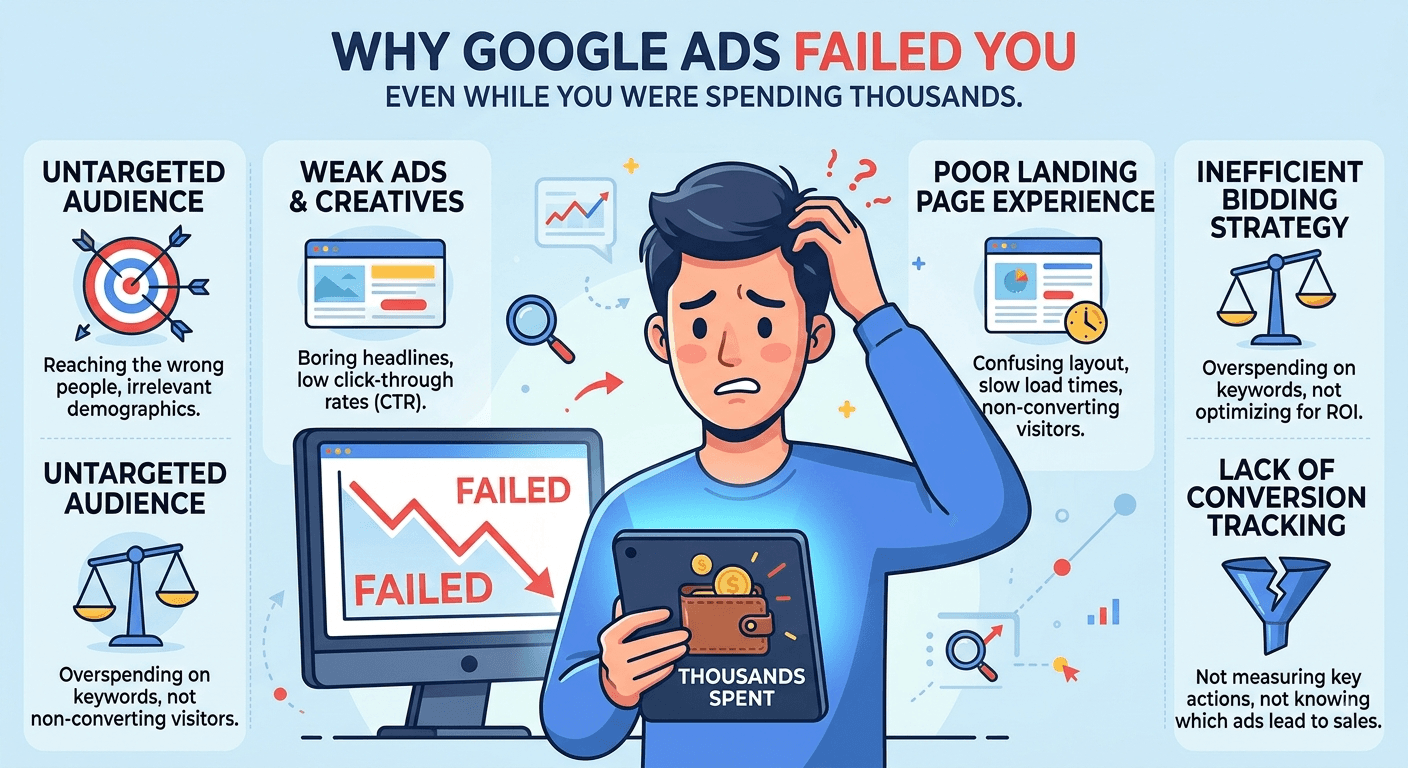
Businesses across the US, UK, Canada, Australia, and New Zealand collectively waste billions on Google Ads every year. Not because the platform does not work. Because of eight specific, fixable mistakes that almost every failing account shares.
The Scale of the Problem
$42 billion is wasted on Google Ads annually by businesses globally. 38% of failing accounts have broken conversion tracking. 20 to 40% of budget is wasted in the average unmanaged account. 91% of keywords in unmanaged accounts produce zero leads. The uncomfortable truth is that Google Ads does not fail because the platform is broken - it fails because the account was set up wrong, left unmanaged, or handed to an agency that did not audit it properly.
Where Your Budget Actually Goes
In the average unmanaged Google Ads account, roughly 35% of budget is consumed by irrelevant search traffic driven by broad match keywords with no negative list. Another 28% of Performance Max budget is misallocated through brand cannibalization and Display overlap. Campaign cannibalization between ad groups with overlapping keywords eats a further 18%. What remains - around 60% at best - is actually reaching high-intent, converting clicks. A well-managed account flips this ratio entirely.
Google Ads does not fail because the platform is broken. It fails because the account was set up wrong, left unmanaged, or handed to an agency that never audited it properly. Every problem below is fixable - without increasing your budget by a single dollar.
Reason 1: Broken or Missing Conversion Tracking
If Google Ads does not know what a conversion is, it cannot optimise toward one. Industry data shows 38% of failing accounts have broken conversion tracking - the most common single cause of wasted spend. Campaigns running without tracking data are asking Google's AI to optimise blind. It guesses. It guesses wrong. And it guesses at your expense.
- The fix: Set up one primary conversion action per campaign mapped to real business value: a phone call, a form submission, a purchase. Add micro-conversions as secondary signals but only let the primary count in your Conversions column.
Reason 2: Broad Match Keywords Without a Negative List
Google's push toward broad match has intensified. Without a comprehensive negative keyword list, broad match vacuums up spend on queries that are irrelevant, tangential, or from completely wrong audiences. A roofing contractor in Phoenix found their ads showing for 'roofing salary' and 'DIY roof repair.' A law firm's ads appeared for 'law school applications.' Each irrelevant click drains budget that should reach an actual buyer.
- The fix: Start every campaign with phrase match and exact match. Build your negative keyword list before launch - not after. At minimum: competitor names, DIY terms, job/career keywords, and any modifier that signals research rather than purchase intent.
Reason 3: Sending All Traffic to the Homepage
A homeowner searching 'emergency roof leak repair near me' clicks your ad and lands on a homepage talking about replacements, gutters, skylights, solar. They leave. That click cost $12 and produced nothing. Conversion rates for campaigns pointing to dedicated landing pages are typically 2 to 5 times higher than those sending traffic to homepages.
- The fix: Each campaign needs its own landing page that mirrors the ad's exact message. If your ad says 'Free HVAC estimate today,' the landing page must lead with that same phrase. No distractions. One CTA. Phone number above the fold.
Reason 4: Messy Campaign Structure With Competing Ad Groups
When multiple ad groups target overlapping keywords, they compete against each other in the same auction. This drives up your own CPC, fragments conversion data, and prevents Smart Bidding from accumulating enough signal to optimise. Google needs at least 30 to 50 conversions per campaign per month to exit the learning phase. Spreading budget across 12 campaigns that each get 3 conversions means none of them ever learn what works.
Reason 5: Wrong Location Targeting Settings
Google's default location targeting setting is 'Presence or interest' - meaning your ads show to anyone who has shown interest in your area, even if they are physically located elsewhere. A plumber in Austin is paying for clicks from people in New York who are planning a move. Unless you sell nationally, this setting alone can waste 15 to 30% of a local campaign's budget. Switch every local campaign to 'Presence only.'
Reason 6: Letting Google's Recommendations Run Unchecked
Google's AI generates recommendations - broaden your keywords, increase your budget, enable more ad types. Many of these benefit Google's revenue more than your ROI. Broad match expansion is a consistent budget leak when applied to accounts without strong conversion history. Advertisers who auto-apply recommendations without reviewing them often see spend increase while leads plateau or decline.
Treat every Google recommendation as a proposal to evaluate, not an instruction to follow. Before applying any recommendation, ask: does this serve traffic with genuine purchase intent, or does it simply expand reach?
Reason 7: Unrealistic Budget for the Target Market
A $500/month Google Ads budget in a market where the average CPC is $8 produces roughly 62 clicks per month. At a 3% conversion rate that is under 2 leads. At a 25% close rate, that might produce one job every two months. The math fundamentally cannot work. Calculate the minimum viable budget before launch. In competitive markets that often means $2,000 to $5,000+ per month.
Reason 8: Slow or No Follow-Up on Leads Generated
The ad worked. The landing page worked. The lead filled out the form. Then nobody called them back for 48 hours. Research shows that responding to an inbound lead within 5 minutes makes you 21 times more likely to win the job compared to a 30-minute response. An hour later, that probability has dropped by 80%. Google Ads generates the opportunity. Your intake process determines whether that opportunity becomes revenue.
The Performance Max Problem
Performance Max now accounts for 45% of all Google Ads conversions globally. The problem is not the campaign type - it is that most accounts feed it the wrong signals. Three traps drain budget consistently: setting the wrong conversion goal (optimising for page views instead of phone calls), no brand exclusions (paying for clicks you would have received organically for free), and Display consuming half the budget while producing under 20% of conversions.
The Audit Checklist - Run This Before Spending Another Dollar
- Pull the search terms report: Check the last 30 days. Count how many queries have nothing to do with your business. That percentage is your approximate waste rate.
- Check your top 5 campaigns: Do they link to a dedicated landing page or your homepage? Homepage equals wasted clicks, every time.
- Open conversion tracking: Confirm each action fires correctly and tracks what actually matters - calls and form submissions, not page views.
- Check your negative keyword list: If it has fewer than 30 terms, it is almost certainly underdeveloped.
- Look at your match types: If more than 40% of spend runs on broad match without strong conversion history, that budget is leaking.
- Check location targeting: Are you running 'Presence or interest' instead of 'Presence only'? Interest targeting serves ads to people researching your area from elsewhere.