
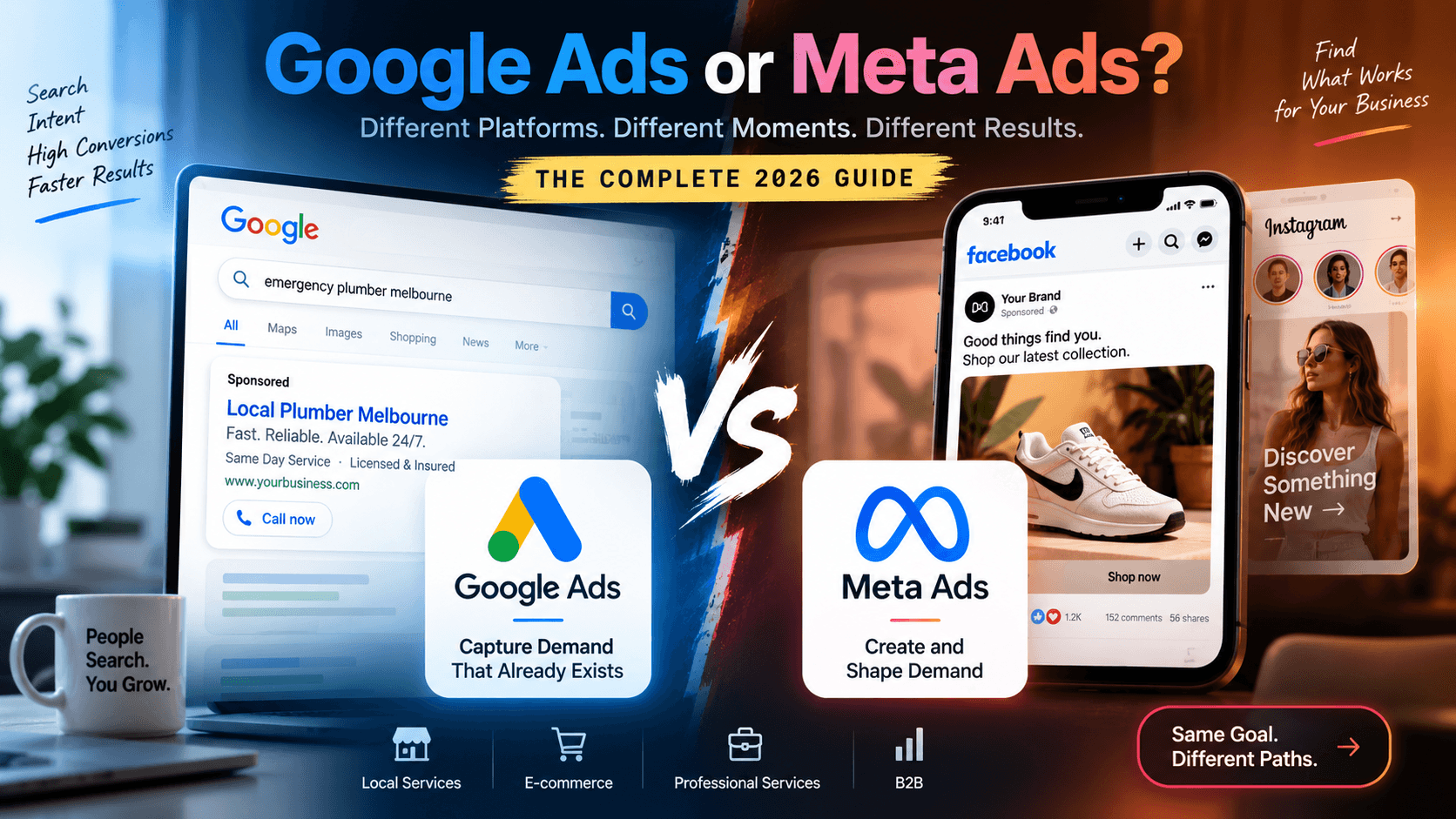
Google Ads or Meta Ads. If you have ever asked this question you are not alone - it comes up in almost every conversation we have with business owners starting or scaling their paid advertising. And the answer is almost never simple. Both platforms can generate leads and sales. Both require budget, time, and expertise to work properly. But they are built for fundamentally different advertising situations, and choosing the wrong one for your business type and goal is one of the most expensive mistakes an advertiser can make.
This guide is built on 2026 benchmark data and what we see across the accounts Luceds manages in the US, UK, Australia, Canada, and New Zealand. Not theory - actual patterns from real accounts across local services, e-commerce, professional services, and B2B.
The Core Difference: Intent vs Discovery
The most important thing to understand about these two platforms is that they reach people at completely different moments in their decision-making process. This single insight explains why one platform works better than the other for different business types.
- Google Ads captures demand that already exists: When someone types 'emergency plumber Melbourne' or 'best accountant for small business' into Google, they have a specific need and they are actively looking for a solution. Google Ads places your business in front of that person at the exact moment they are ready to act. This is why Google Ads consistently produces faster conversions for service-based businesses - you are not convincing anyone they need a plumber, you are simply showing up when they have already decided they do.
- Meta Ads creates and shapes demand: When someone scrolls Instagram or Facebook, they are not searching for anything. They are browsing content, watching videos, and catching up with friends. Meta places your ad into that flow and relies on creative content, visual appeal, and repeated exposure to generate interest in something the person was not already looking for. This is why Meta works so well for products people discover visually - fashion, food, fitness, beauty, and lifestyle brands - and why it is harder to make work for urgent service-based needs.
The platform was never the problem. The mismatch between the platform and the business type was. Google Ads and Meta Ads are not competitors - they are tools built for different jobs.
Cost Comparison: What You Actually Pay in 2026
The most misleading comparison made between Google Ads and Meta Ads is cost per click. Meta Ads have a lower average CPC at around $0.70 for traffic campaigns compared to $5.42 for Google Ads according to 2026 WordStream benchmark data. But this comparison is almost meaningless without context. A $0.70 click from someone scrolling Instagram who has no intent to buy converts at a fraction of the rate of a $15 click from someone who searched for your exact service. The right comparison is always cost per lead or cost per acquisition.
- Google Ads CPC by industry in 2026: Legal and financial services average $47 to $80 per click at the high end. Home services like HVAC, plumbing, and roofing average $8 to $25 per click. E-commerce averages $1 to $4 per click. Professional services like accounting and consulting average $5 to $20 per click. These are high costs per click but they come from people actively searching - conversion rates are typically 3 to 8 times higher than equivalent Meta traffic.
- Meta Ads cost structure in 2026: Meta charges primarily on a CPM basis - cost per 1,000 impressions - which averaged $8 to $14 across most industries in 2026. The effective CPC is low but conversion rates from cold traffic are also low, typically 0.5 to 2% for most offers compared to 3 to 10% for Google Search. Meta Ads can produce a lower cost per lead than Google in some categories, particularly e-commerce and visual products, but this requires strong creative and a well-structured funnel.
- The budget threshold matters: Both platforms need enough conversion data to optimise effectively. Google's Smart Bidding works best with 30 to 50 conversions per month per campaign. Meta's algorithm needs 50 or more conversion events and 7 to 14 days minimum before exiting the learning phase. Under $500 per month on either platform, you may not generate enough volume for the algorithm to work properly. If your budget is under $1,500 per month, focus everything on one platform rather than splitting spend.
Which Platform Fits Which Business Type
After managing accounts across dozens of industries, the pattern is clear. Business type and purchase intent are the two factors that most reliably predict which platform will produce better results. Here is how we think about it at Luceds.
- Start with Google Ads if you are a local service business: Plumbers, electricians, HVAC companies, roofers, dentists, lawyers, accountants, and any business where people search Google when they need your service should start with Google Ads. The search intent is already there. You are capturing a need that exists, not creating one. Local service businesses in urgent-need categories consistently see faster results and more predictable cost per lead on Google than on Meta.
- Start with Meta Ads if you sell a visual or lifestyle product: E-commerce brands, fashion, beauty, fitness, food, home decor, and any business where seeing the product creates the desire to buy should start with Meta. Instagram and Facebook Reels, carousels, and collection ads are built for product discovery. The visual format does the selling work that a text search ad cannot. If your product needs to be seen to be wanted, Meta is your platform.
- Start with Google Ads if you sell a professional B2B service: Software, consulting, agencies, HR services, and any business where buyers research extensively before contacting a provider should start with Google. Business buyers search terms like 'Google Ads agency Sydney' or 'accounting software for small business' with clear intent. Capturing that search traffic converts more efficiently than trying to interrupt someone browsing LinkedIn or Facebook.
- Meta works better for new brands building awareness: If you have a new brand that nobody has heard of, Google Ads will not help much because nobody is searching for you by name. Meta lets you put your brand in front of a targeted audience repeatedly until they become familiar with it. Once brand awareness is established and people start searching for you, Google captures that demand efficiently.
- E-commerce businesses above $5,000 per month should run both: For e-commerce brands with adequate budget, the strongest approach is Meta Ads for discovery and retargeting combined with Google Shopping and Search for capturing existing demand. Meta builds the awareness and introduces products to new audiences. Google captures people who have been introduced to the brand and are now actively searching. This combination consistently outperforms either platform alone.
How AI Has Changed Both Platforms in 2026
One of the most significant shifts in 2026 is how thoroughly artificial intelligence manages both platforms. This changes what advertisers need to focus on and what decisions still require human judgment.
- Google Performance Max has changed campaign management: Performance Max campaigns have largely replaced individual Search, Display, Shopping, and YouTube campaigns for most Google Ads advertisers. PMax uses Google's AI to allocate budget across all these channels automatically. This is good for efficiency but reduces control. Advertisers who understand how to structure asset groups, feed PMax the right conversion data, and set appropriate bidding targets still outperform those who treat it as a set-and-forget system.
- Meta Advantage Plus has done the same on Facebook and Instagram: Meta's Advantage Plus Shopping campaigns and automated audience tools have shifted the platform toward AI-managed targeting. In 2026, Meta's algorithm is good enough that overly narrow audience targeting often underperforms broad targeting with strong creative. The creative - the video, the image, the copy - is now the primary lever advertisers control on Meta. The algorithm handles audience targeting and placement allocation.
- What this means for your strategy: On both platforms in 2026, your most important job as an advertiser is feeding the AI the right inputs. On Google, that means accurate conversion tracking, complete first-party data, and correct campaign structure. On Meta, that means strong creative that hooks attention in the first 3 seconds, clear offers, and enough conversion data for the algorithm to find buyers. The platforms manage the tactical execution. Strategy, creative, and data quality are what separate winning accounts from losing ones.
The Combined Strategy: When to Run Both
For businesses with monthly ad budgets above $3,000 and a product or service that works on both platforms, running Google and Meta together in complementary roles consistently outperforms either platform alone. The structure that works across most industries is straightforward.
- Google Search captures bottom-funnel demand: Run Search campaigns targeting people actively looking for your service or product. These are your highest-intent clicks and your most efficient conversion campaigns. This is where your budget gets the most predictable return.
- Meta builds top-funnel awareness: Run Meta campaigns targeting cold audiences with video or image creative that introduces your brand, showcases your product, or builds credibility with case studies and testimonials. These campaigns do not convert immediately but they feed future Google search volume.
- Meta retargets Google visitors: This is the highest-ROI use of Meta Ads for most businesses. People who clicked your Google ad but did not convert are already qualified - they searched for your service and showed interest. Retargeting them on Facebook and Instagram with a different angle, a testimonial, or a specific offer closes sales that would otherwise be lost.
- Google captures brand searches from Meta exposure: As Meta builds awareness, people will start searching for your brand name on Google. Brand Search campaigns are cheap and capture this high-intent traffic before competitors can intercept it with their own ads.
Making the Decision for Your Business
If you are still unsure which platform to start with, answer these three questions. First, do people search Google when they need what you sell? If yes, start with Google. Second, does seeing your product create the desire to buy it? If yes, Meta is likely more powerful. Third, what is your monthly budget? Under $1,500 per month, pick one and go all in. Above $3,000, test Google first and add Meta once Google is profitable.
At Luceds, we audit accounts on both platforms. The most common mistake we see is business owners running both platforms with a split budget before either has enough data to optimise. A $2,000 per month budget split $1,000 each to Google and Meta will almost always underperform a $2,000 per month Google-only or Meta-only campaign, because neither platform has enough conversion volume to learn effectively. Budget concentration beats platform diversification at early spend levels.